


09 Jul Guadalajara, Where Mexican Traditions Come Alive
If you walk through the streets of Guadalajara, you won’t just see Mexican culture; you will feel it through every mariachi note, every hand-painted ceramic piece, and every family gathering around a steaming pot of birria. This is the city where not only some of the most iconic Mexican traditions were born, but continue to evolve while staying true to their roots.
Guadalajara traditions aren’t museum pieces or folklore preserved behind glass. They’re living, breathing parts of daily life. A grandfather teaching his grandson to lasso, an abuelita passing down her mole recipe, and the street corner where musicians tune their instruments as the sun sets.
The Sound of Mexico: Mariachi
The soaring trumpets, the rhythmic strum of vihuelas, voices harmonizing in that recognizable mariachi sound. Listen to the city, this is the music’s birthplace.
Plaza de los Mariachis pulses with music every night. These aren’t performers putting on a show. These are musicians who learned from their fathers, who learned from their fathers, carrying forward a tradition that UNESCO recognizes as Intangible Cultural Heritage of Humanity.
Mariachi tells stories of love and heartbreak, of revolutionary heroes, of celebrations. When a family hires a mariachi group, they’re not just booking music. They’re keeping alive a cultural thread that connects modern Guadalajara to its roots with joy.
To experience mariachi at its most elegant, catch the Galas del Mariachi at Teatro Degollado during the annual Encuentro Internacional del Mariachi y la Charrería. Watching top mariachi groups perform alongside the Jalisco Philharmonic Orchestra in that stunning 1866 theater, traditional songs swelling with symphonic arrangements, is the kind of performance that gives you chills. Find more here.
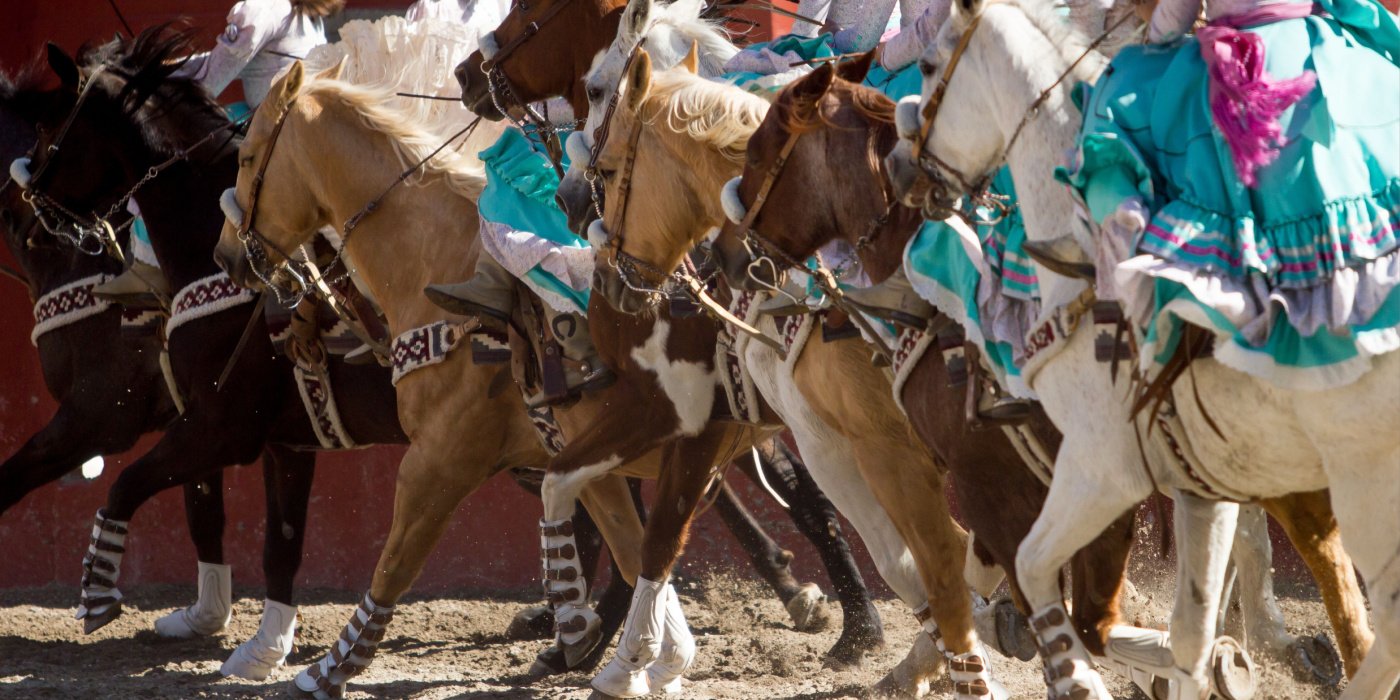
Charro Culture: Pride on Horseback
Long before the American cowboy became an icon, Mexican charros were perfecting their equestrian skills in these fields. These skills would later influence ranching culture across the American West. The charro tradition has deep roots in Jalisco, back to the 16th century when Spanish ranches required skilled horsemen.
The charro isn’t just a guy in a fancy suit. It’s a symbol of Mexican identity, a living connection to the ranch culture that shaped this region. Watch a charrería, which is the Mexican rodeo, and you’re seeing skills passed down through bloodlines. Each event requires years of training and a bond between horse and rider that can’t be faked.
The charro’s suit, heavy with silver embroidery, represents honor, tradition, and family legacy. When a young man enters the rodeo with his family watching, he’s stepping into generations of history. In Guadalajara, charreadas still happen most Sundays, which involve families packing arenas, and afterwards sharing food.
Festivals and Celebrations
Guadalajara culture reveals itself most vividly during its celebrations. The Fiestas de Octubre transform the city for an entire month with art exhibitions, traditional dance performances, rodeos, and gastronomic fairs showcasing Jalisco’s heritage. Find more here.
Day of the Dead offers a more intimate look at tradition. Families genuinely honor their dead by building elaborate offerings, preparing the deceased’s favorite foods, spending the night in cemeteries, and sharing stories. The marigold and the pan de muerto aren’t decorations. They’re a bridge between worlds.
Handcrafting: Keeping Tradition Alive
It will take nothing but a day trip to Tlaquepaque and Tonalá, and you’ll understand why Guadalajara traditions include some of Mexico’s finest craftsmanship. These neighboring towns have been centers of ceramic and glasswork for centuries.
Walk into a workshop, and you realize it’s not about the objects, but about the hands making them. The artisan who learned to blow glass from his father, aunt, or grandpa, who experimented with traditional techniques to create something new while respecting the old. Young artists are reimagining folkloric designs for modern homes, proving that tradition doesn’t mean frozen.
Food as a Love Language
If you ask anyone about Guadalajara traditions, food will dominate the conversation. Here, cooking isn’t just sustenance, it’s storytelling, heritage, love made tangible.
Take Birria, Jalisco’s iconic dish, as an example. The recipe might vary by family. Grandmothers guard their particular method, each claiming theirs is the authentic one. And they’re all right, because authenticity isn’t about a single correct recipe, it’s about the care, the time, the gathering around a steaming pot on Sunday morning.
Or take tortas ahogadas, those “drowned” sandwiches soaked in spicy tomato sauce. Locals argue passionately about which place makes them best, because food here is identity, pride, and home.
Faith, Family & Modern Life
Understanding Guadalajara culture is understanding the role of faith and family. The Virgin of Zapopan’s pilgrimage draws over a million people each October. They walk kilometers accompanying the statue to its designated church, praying and singing, like a renewal of faith and community bonds.
Now, here’s what makes Guadalajara traditions so important: they’re not static. Guadalajara is also Mexico’s Silicon Valley, a hub of tech innovation. Young people might work in startups by day and attend charrería on weekends. They’re also creating fusion cuisine that respects traditional flavors while pushing boundaries.
Walking through Guadalajara, you’ll see it everywhere: the food truck serving gourmet birria tacos, the contemporary art gallery in a restored colonial building, and the tech worker taking guitar lessons to join a mariachi group. This is a city of people who know where they come from and aren’t afraid of where they’re going.
For those looking for authentic Mexican experiences, Guadalajara offers something increasingly rare: a major city where traditions aren’t preserved like artifacts, but alive. Come for the mariachi, the tequila, the food. Stay because you felt something shift when a grandma welcomed you to her table like family, when you watched a young charro compete next to his grandfather. Guadalajara traditions aren’t about Mexico’s past; they’re about what makes it eternally vibrant.