


09 Jul José Clemente Orozco Paintings: A Journey Through Guadalajara’s Soul
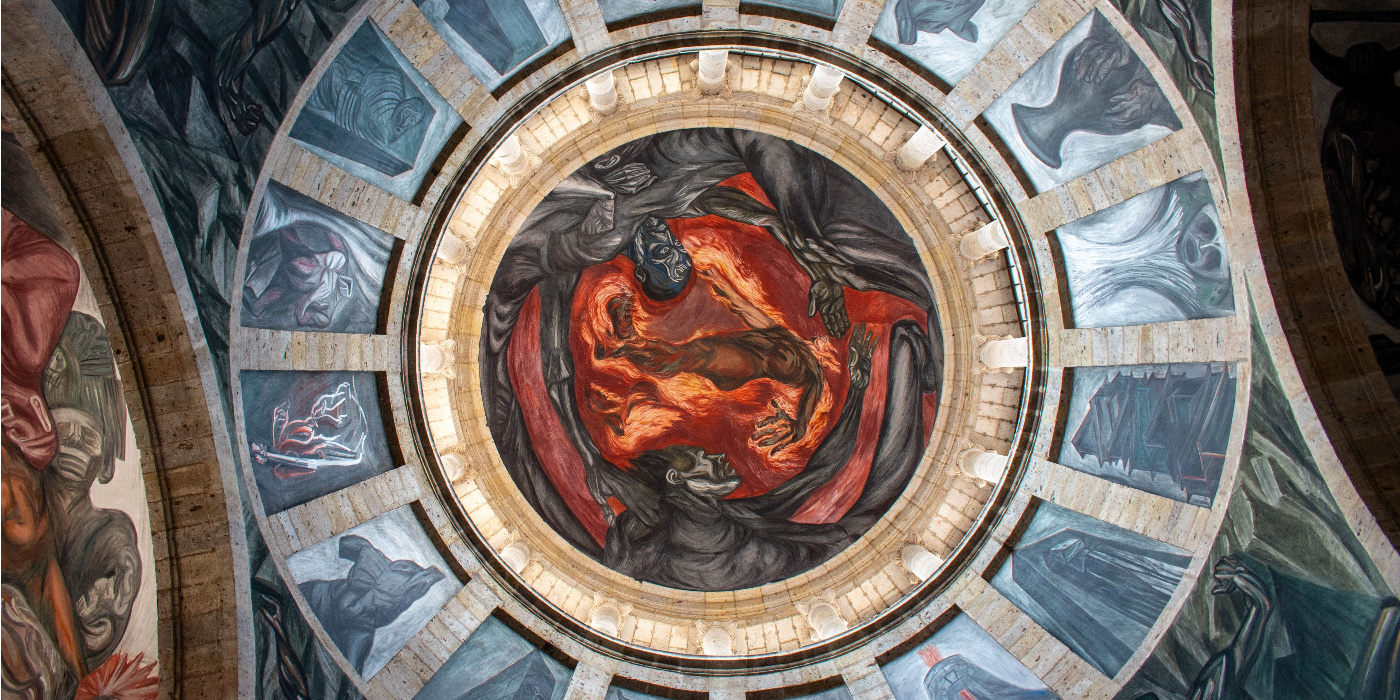
Stand under the dome of Hospicio Cabañas and tilt your head back. Orange and red pigment swirl overhead, a man wrapped in flame reaching toward the light. That’s what José Clemente Orozco’s paintings feel like at their most overwhelming, and Guadalajara is where you feel them best. Long before museums in New York or Chicago claimed pieces of his legacy, this city gave him walls, ceilings, and three of the most intense years of his working life.
Who Was José Clemente Orozco? Jalisco’s Revolutionary Artist
Orozco was born in 1883 in Zapotlán el Grande, now Ciudad Guzmán, a couple of hours from Guadalajara. At 21, he lost his left hand in an accident with gunpowder, then went on to train at Mexico City’s Academia de San Carlos. Where Diego Rivera arranged crowds like choreography and David Alfaro Siqueiros chased motion and machinery, Orozco worked in angles and shadow. His figures twist, strain, burn. He wasn’t interested in flattering anyone, not conquerors, not revolutionaries, not the Church, and that refusal to pick a hero is what still makes his murals feel unsettled, decades on. You can trace how that vision fits into the wider story of Jalisco artists who shaped the city’s identity: Guadalajara artists who made history
Where His Paintings Come Alive in Guadalajara
The Man of Fire at Hospicio Cabañas
Between 1938 and 1939, Orozco covered the old hospice chapel with 57 fresco panels. The centerpiece, El Hombre de Fuego, spans roughly 11 meters across the dome, some 25 meters above the floor. Painted mostly with his right hand on wet plaster that left no room for correction, it still reads as urgent, a body consumed and somehow triumphant at once.
Government Palace: Political Fire on the Walls
A short walk away, the Government Palace holds his 1937 staircase mural, where Miguel Hidalgo looms over a churning mass of soldiers and symbols. It’s one of Orozco’s sharpest political statements, painted inside a building that still functions as Jalisco’s seat of government today.
Prometheus and the University of Guadalajara
Inside the Paraninfo and the Iberoamerican Library at Universidad de Guadalajara, murals from 1936 and 1937 show Orozco refining ideas he’d first tested in Prometheus, painted at Pomona College in California back in 1930. That earlier U.S. commission pushed him toward the geometric simplification you can trace straight through to the Cabañas dome.
Plan your visit ahead
Hospicio Cabañas is open Tuesday through Sunday, 10:00 am to 6:00 pm, closed Mondays. General admission runs around 80 pesos, with discounts for teachers, students, and seniors, and free entry on Tuesdays.
The Government Palace and the Universidad de Guadalajara sites are free to enter, though the Palace closes access during official ceremonies.
Give Cabañas two to three hours on its own; all three sites sit within about 2.5 kilometers of each other in the historic center, so a full morning covers everything comfortably. Photography is allowed without flash, and guided tours run in Spanish and English with advance reservation.
For a broader walk through the historic center around these sites, this guide is a good companion: What to Do in Guadalajara: A complete guide to explore the jewel of Jalisco
This summer enjoy the exhibit – Travesías por México: Territorios y raíces (2026)
Through August 2, 2026, Cabañas pairs Orozco with this Banco Nacional de México collection show, marking the first time a Frida Kahlo painting has traveled to Guadalajara. Diego Rivera’s Vendedora de alcatraces hangs nearby, alongside Siqueiros and Tamayo. Worth the extra hour before you leave. Confirm current listings before your visit, since the lineup rotates.
FAQs about José Clemente Orozco Paintings
Where can I see José Clemente Orozco paintings?
Guadalajara holds his largest and most complete mural cycle, split between Hospicio Cabañas, the Government Palace, and Universidad de Guadalajara. Mexico City and a handful of U.S. campuses, including Dartmouth College, hold other major works.
What is Orozco’s most famous painting?
El Hombre de Fuego, in the Cabañas dome, is the one most people picture first. La Trinchera, an earlier canvas, is considered historically just as important, though the original no longer survives.
How long should I plan for the Orozco mural sites?
Give Hospicio Cabañas alone two to three hours. Add the Government Palace and the Paraninfo, and you’re looking at a full morning, closer to five or six hours if you want to linger over every panel.
Can I take photos of the murals?
Yes, without flash, at Hospicio Cabañas. Rules at the Government Palace can shift depending on what’s happening there that day, so it’s worth asking staff on arrival.
Are the murals accessible for visitors with mobility issues?
Hospicio Cabaña’s ground floor is fully accessible, and the dome is visible from below without climbing stairs. The Government Palace staircase mural is harder to reach by wheelchair, though some ground-floor panels remain viewable.
There’s something different about seeing José Clemente Orozco paintings where he actually painted them, the plaster still holding the marks of a single working hand. Guadalajara doesn’t ask you to imagine his world; it hands you the room he built it in. Save this guide, pick a morning, and go stand under that dome yourself.